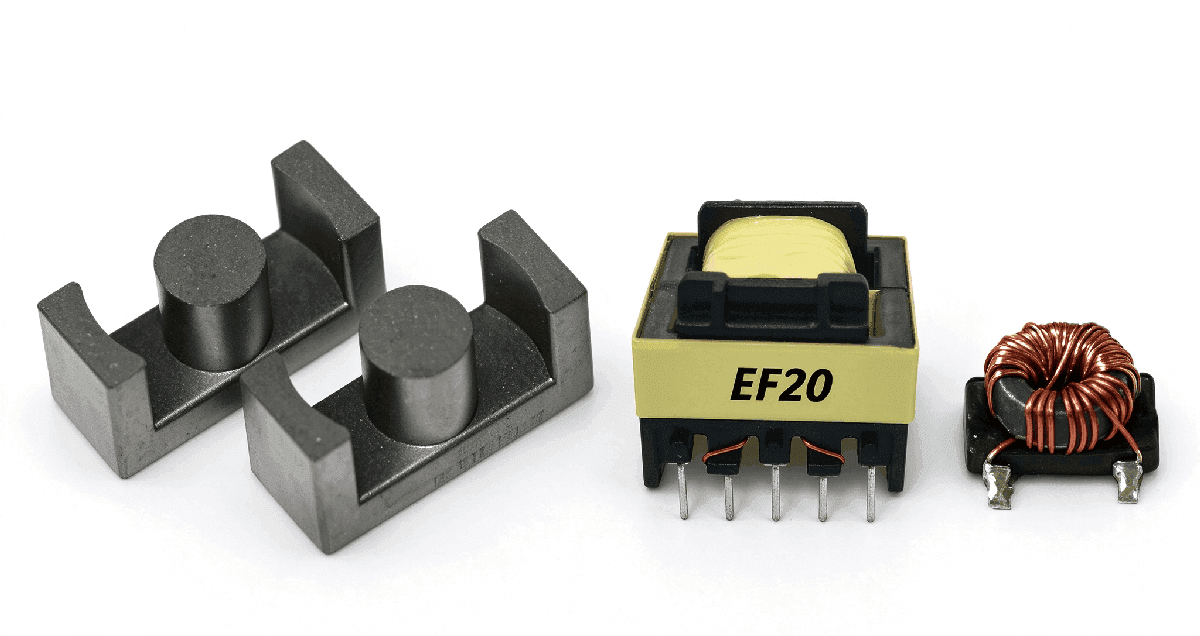
Custom flyback transformers are the heart of any reliable SMPS power supply. Among all customizable elements, the ferrite core selection stands out as one of the most decisive factors that directly shape your power supply’s efficiency, thermal performance, operating frequency and overall size. Whether you are designing a low-power auxiliary supply or a high-density industrial switching power supply, picking the right ferrite core cannot be overlooked.
Ferrite cores for flyback transformers are commonly made of manganese-zinc (MnZn) ferrite material, optimized for high-frequency switching scenarios. Different core geometries also bring distinct advantages. Popular options including EE, EF, ETD and RM cores are widely adopted in SMPS projects. For example, EE cores such as EE13 and EE16 feature a simple winding structure and cost-effective production, which makes them ideal for low-to-medium power consumer and industrial power supplies. EF cores deliver a more compact footprint while maintaining good magnetic performance, perfect for PCB layouts with strict space limits. If your design targets higher power and better heat dissipation, ETD series cores are usually the preferred choice.
When evaluating a ferrite core for your custom flyback transformer, you need to check several key parameters first. Saturation flux density is critical: if the core saturates under peak current, your power supply will suffer from sharp efficiency drop, excessive heating and even failure. Core loss is another major index. At your designed switching frequency, lower core loss keeps the transformer running cooler and reduces thermal design pressure. You also need to consider the effective cross-sectional area, magnetic path length and available winding window area. The window size determines how many copper windings and insulation layers you can fit in, which matters a lot for high-voltage isolation requirements.
Apart from core material and shape, air gap design works hand in hand with the ferrite core. A properly set air gap prevents saturation and increases the energy storage capability of the flyback transformer. This is a unique requirement for flyback topology, since flyback transformers store energy in the magnetic gap during the switch-on phase. Our team can calculate and reserve a suitable air gap based on your input voltage range, output power and peak current specification.
If you want to explore available core options and customize a flyback transformer matched to your SMPS specification, check our custom flyback transformers product range. We offer EE13, EE16, EF20, ETD34 and other mainstream series, and support fully customized winding, pin assignment, bobbin and insulation class according to your drawings.
It is worth noting that core selection never works in isolation. Your chosen ferrite core must coordinate with winding gauge, number of turns, bobbins and isolation standards. A core with excellent raw performance will not deliver good results if the winding layout is poorly designed. Many engineers tend to select a core only by power rating, ignoring the working frequency and ambient temperature. This often leads to overheating problems in mass production.
Before confirming your custom flyback transformer order, share your full design requirements: switching frequency, maximum output power, input voltage range, isolation voltage requirement and working environment temperature. Our engineers will help you filter the most suitable ferrite core and complete the whole transformer design, prototype and volume production.
FAQ
Q: Which ferrite core is best for low-power SMPS flyback transformers?
A: EE13 and EE16 ferrite cores are the most mature choices for low-power flyback designs. They balance cost, size and magnetic performance well for many small switching power supplies.
Q: Does a larger ferrite core always mean better performance?
A: Not exactly. An oversized core will increase material cost and the overall PCB footprint. You need to match the core size precisely to your power level and switching frequency.
Q: Can you adjust the air gap on the ferrite core for our flyback design?
A: Yes. Air gap customization is a standard part of our flyback transformer service. We tune the gap to avoid saturation and meet your energy storage demands.